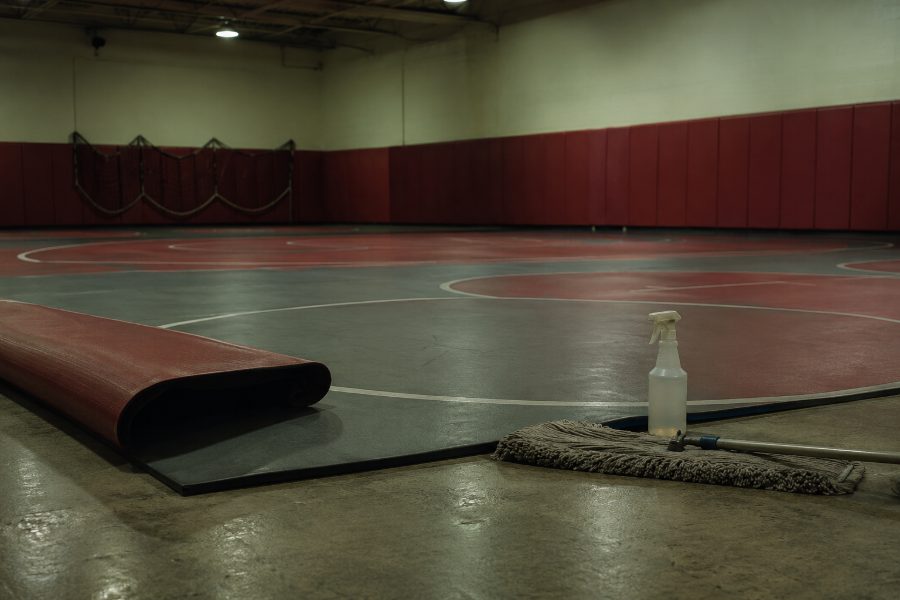
Mats, pads and locker rooms — where MRSA and ringworm actually spread.
A wrestler can be cleared to return to school under Texas rule the day treatment starts, and still be ineligible to step on a mat for another 72 hours under the competition rule. Most athletic departments don't know those are two different standards. That gap is where outbreaks live.
Three separate systems govern your facility, and they don't agree with each other. Sorting that out is most of the value here.
1. The competition rules — binding on your athletes
NFHS Wrestling Rule 4-2-3: a wrestler suspected of a communicable skin disease must produce written documentation from a health-care professional, furnished at the weigh-in, stating the condition is not communicable. And critically:
"Covering a communicable condition shall not be considered acceptable."
UIL adopts NFHS — UIL Constitution & Contest Rules §1350(f) provides that UIL tournaments are conducted under National Federation rules. So NFHS Rule 4-2 is the operative standard in Texas high school wrestling.
NFHS Medical Release Form (rev. April 2025) — minimum time before return:
Condition
Minimum
Bacterial (impetigo, boils, MRSA)
72 hours oral antibiotic; no new lesions 48 hrs; scabbed, no drainage
Tinea corporis (body ringworm)
72 hours topical antifungal
Tinea capitis (scalp ringworm)
14 days oral antifungal
Herpes gladiatorum, first episode
10 days (14 if systemic symptoms)
Herpes, recurrent
120 hours oral antiviral, lesions scabbed
For Texas colleges — NCAA/NCWWC 2025-26 Rule 1-2-1 is the most explicit mat rule in existence: mats "required" to be cleaned and disinfected prior to each day of competition, and recommended before subsequent rounds. Rule 6-1-21: blood on the mat cleaned and disinfected before the match resumes.
2. The Texas school rule — and the gap
25 TAC §97.7 requires school administrators to exclude a child with a communicable condition. Per the DSHS chart (rev. 3/4/2024): ringworm — no exclusion if it can be covered, otherwise readmit once treatment has begun. Impetigo — readmit when drainage is contained in a clean dry bandage.
Here's the gap, and it's the most useful thing on this page:§97.7 lets a ringworm case back into class the day treatment starts. The NFHS form requires 72 hours of antifungal — 14 days for scalp — before that same athlete returns to the mat, and forbids covering it. A school can be perfectly §97.7-compliant and still forfeit a match.
There is no athletics-specific Texas exclusion rule. §97.7 is it. The stricter standard comes from the governing body, not the state.
3. Facility cleaning — mostly guidance, and I'll say so
UIL Wrestling Manual, "Guidelines to Reduce the Incidence of Skin Disease":
"Clean wrestling mats daily, preferably within one hour of practice or competition, using a disinfectant cleaner. Allow mats to air dry before using."
Also: disinfect mats 1–2× weekly, wipe weight-room benches before and after use, launder practice gear after each use, disinfect headgear and shoes after practice, shower after every practice.
UIL Blood Clean Up Procedures call for a bleach solution at mat side and require gloves for anyone removing blood.
These are titled Guidelines. UIL has no rule mandating a cleaning frequency, product, or contact time. I'd rather tell you that than pretend otherwise — the reason to clean the mat daily is that it works, not that you'll be penalized.
NATA Position Statement (2010) is the strongest disinfectant-specific citation available:
"Daily cleaning of the mats with chlorine-containing disinfectant sprays, at least during the course of the competitive season, is recommended."
"The type of disinfectant… should be registered with the Environmental Protection Agency, and the manufacturer's recommendations for amount, dilution, and contact time should be followed."
CDC MRSA guidance for athletic facilities (reviewed June 2025) — and this one cuts against a lot of chemical marketing, including some of mine if I weren't careful:
"Products effective against Staphylococcus aureus are sufficient to kill MRSA."
"There is little evidence that large-scale use of disinfectants will prevent MRSA infections better than a targeted approach of cleaning surfaces."
So I'm not going to sell you exotic chemistry. The differentiator is contact time and targeting the surfaces that touch bare skin — which is exactly what CDC says works.
4. Bloodborne pathogens — depends who signs the checks
Private gyms, health clubs, private schools, club programs → OSHA 29 CFR 1910.1030 applies directly. Written exposure control plan, free PPE, surfaces decontaminated "with an appropriate disinfectant."
Public ISDs, community colleges, public universities → federal OSHA does not reach you. An OSHA interpretation letter from September 25, 2000 — written about Texas athletic trainers specifically — says so. You're covered instead by Health & Safety Code §81.304 / 25 TAC Ch. 96, with the DSHS model plan.
Note that OSHA says "an appropriate disinfectant." There is no such thing as an OSHA-approved disinfectant. EPA registers products; OSHA doesn't. Any rep telling you a product "meets OSHA requirements" is selling you a phrase that doesn't exist.
The claims rule
Only claim MRSA if the product is on EPA List H. Only claim HIV/HBV/HCV if it's on List S. Off-label public health claims violate FIFRA. [LIST: confirm which SKUs appear on List H and List S]
Your mat product. Label claims include MRSA, Herpes 1 & 2, VISA TB, HIV-1, HBV, HCV, Norovirus[VERIFY against master label] — herpes and staph are precisely the wrestling-room organisms. The builders matter here: a mat carries body oil and skin cells, and a straight quat without cleaning power just redistributes it.
Dilution [LABEL: Greg to confirm] · Contact time [LABEL: Greg to confirm]
Entry, exit, and stations where there is no sink. Rub in until dry. The tech data sheet says it helps reduce bacteria on the skin. It is not a surface disinfectant — benches, bars, and locker hardware get D-S-D.
Pads, headgear straps, bags, upholstered training tables, wrestling room walls. Fabric and foam are where a wrestling room's smell lives, and no hard-surface disinfectant touches them.
Locker room floor drains and shower drains. Digests the organic material feeding the smell instead of covering it. A locker room that smells after you clean it has a drain problem, not a surface problem.
Blood on the mat, mid-match. Gloves on, solidify, remove, then disinfect with D-S-D before play resumes. Faster than towels and keeps your responder's hands out of it — which is the actual point of universal precautions.
Cleaning schedule
Your cleaning schedule
Wrestling / mat rooms — daily in season
Task
Product
Timing
Full mat clean and disinfect
D-S-D
Within 1 hour of practice or competition (UIL guideline). Surface stays visibly wet for full contact time [LABEL], then air dry before use
Ringworm transmission from bare feet on shared floors is CDC-documented
Locker handles, faucets, door pulls
D-S-D
Floor drains
DYNASTY MICRO BC
Weekly minimum
Weekly
Deep mat disinfection (UIL: 1–2× weekly beyond the daily clean)
Full fabric treatment — pads, bags, upholstery — with SHA-BRZ
Drain treatment throughout
Restock mat-side blood kit: gloves, EXTRA-SORB, D-S-D, disposal bag
Every practice, by the athletes
Shower immediately. Launder practice gear after every use. No shared towels or razors. Cover cuts with clean dry bandages. Barrier — clothing or towel — between skin and shared surfaces. (CDC athlete guidance, reviewed June 2025.)
Straight answers
Questions I get
For high school in Texas: no binding rule. UIL's guideline says daily, within an hour, with a disinfectant cleaner. For NCAA programs, Rule 1-2-1 requires cleaning and disinfection prior to each day of competition. I'd hold to the daily standard either way — the outbreak data is what makes the case, not a penalty.
CDC says no: products effective against Staph aureus are sufficient to kill MRSA, and there's little evidence that heavy disinfectant use beats targeted cleaning. If you want to make a MRSA claim on a label, the product needs to be on EPA List H. What actually matters is contact time and hitting the bare-skin surfaces.
No. NFHS 4-2-3 is explicit — covering a communicable condition is not acceptable. He can go to class under §97.7 once treatment begins. He cannot go on the mat for 72 hours of antifungal therapy, and 14 days if it's scalp.
Private facility: yes. Public school district or public college in Texas: no — federal OSHA doesn't cover Texas public employees. You're under Health & Safety Code §81.304 and 25 TAC Ch. 96 instead, and DSHS publishes a model exposure control plan.
Drains. Almost always drains. Hard-surface disinfectant does nothing for organic buildup in a drain line — that's what DYNASTY MICRO BC is for.
Let me walk your building. It's free, and it takes about an hour.