Documented dwell times and surface compatibility for equipment you can't afford to pit.
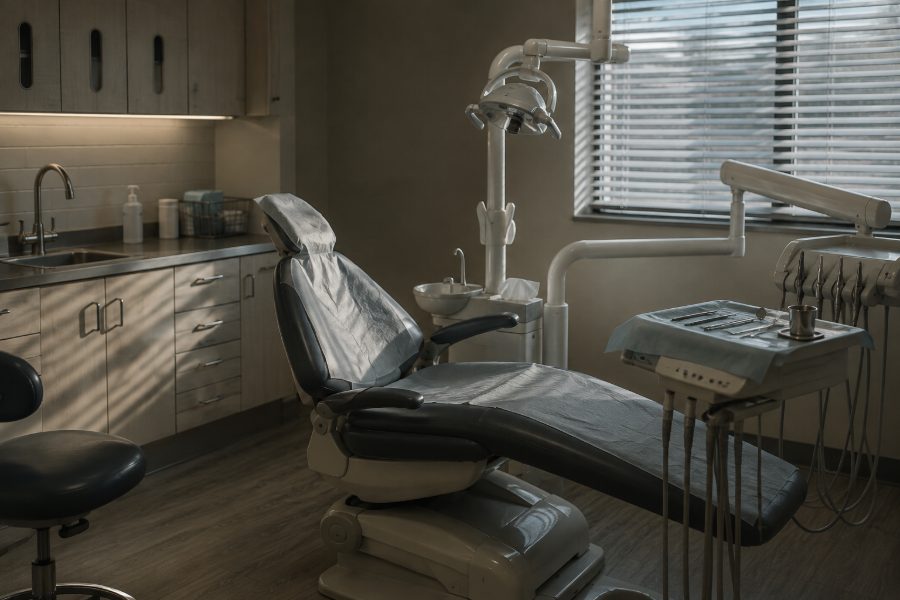
Two things get an office in trouble: a disinfectant used for less than its labeled contact time, and a disinfectant that's slowly destroying a $40,000 chair. Both are avoidable, and both come down to matching the product to the surface and documenting it.
For environmental and housekeeping surfaces, this — not CDC, and not the dental board — is what makes decontamination mandatory. (The dental board does reach contaminated operatory equipment — see §108.24(c) below.) §1910.1030(d)(4)(ii)(A), verbatim, gives you three triggers:
Contaminated work surfaces shall be decontaminated with an appropriate disinfectant after completion of procedures; immediately or as soon as feasible when surfaces are overtly contaminated or after any spill of blood or other potentially infectious materials; and at the end of the work shift if the surface may have become contaminated since the last cleaning.
§(d)(4)(ii)(B) requires protective coverings — barrier wrap, imperviously-backed absorbent paper — to be replaced when overtly contaminated or at end of shift.
Note the wording: "an appropriate disinfectant." OSHA doesn't name EPA lists in the rule text and doesn't approve products. There is no OSHA-approved disinfectant.
One jurisdictional note. Federal OSHA covers private practices — which is most of this page's audience. It does not cover Texas public employees, because Texas has no OSHA State Plan. If you're a city or county health clinic, a public hospital district dental clinic, an ISD school-based health center, or a public college hygiene clinic, your hazard communication obligations run through the Texas Hazard Communication Act (Health & Safety Code Ch. 502 / 25 TAC Ch. 295, enforced by DSHS), and your bloodborne pathogen obligations through HSC §81.304 / 25 TAC Ch. 96. The surface protocols below don't change. The citation on your compliance file does.
Written program, SDSs accessible each shift, training at assignment, and secondary container labeling. That last one is your most common real-world exposure: decanted disinfectant in an unlabeled spray bottle is a citable violation. The consumer-product exemption at (b)(6)(ix) does not cover professional-strength disinfectants used all day.
Texas dental — and a correction worth having
The Texas rules are at 22 TAC Chapter 108, Subchapter B — "Sanitation and Infection Control," §§108.20–108.24. Not §108.7, which is "Minimum Standard of Care, General." A §108.7 emergency rule existed during COVID and has expired; a lot of vendor material still cites it wrongly.
§108.21: a dentist "must maintain the entire dental office in a clean and sanitary condition," in compliance with city and county health requirements and Texas health laws. It references neither CDC nor OSHA.
§108.24(c): instruments and operatory equipment contaminated with blood, saliva, or tissue debris must be "at a minimum, disinfected and preferably sterilized by a CDC or ADA-approved method before utilization again for patient care."
Be precise about what that means. Texas requires a CDC- or ADA-approved method. It does not incorporate the CDC dental guidelines wholesale as enforceable state law. Anyone telling you "Texas law requires CDC guideline compliance" is overstating it. And there is no mandatory infection control CE for Texas dentists, hygienists, or assistants — I verified all three.
(Re-verify §108.21 and §108.24 against the current Texas SOS portal before you rely on them — the state's rule viewer migrated and the mirrors I used show a 2001 effective date with no amendment history displayed.)
For Texas medical offices: there is no Texas Medical Board rule specific to surface disinfection in a private physician's office. Your binding authority is essentially OSHA plus the EPA label. I'd rather name that gap than fill it with dental citations that don't apply to you.
CDC — recommended, and it's the standard of care
CDC's Summary of Infection Prevention Practices in Dental Settings draws the distinction your product selection turns on:
"should be barrier protected or cleaned and disinfected between patients."
Routine: an EPA-registered low-level hospital disinfectant effective against HIV and HBV.
Visibly contaminated with blood: use an intermediate-level disinfectant (tuberculocidal claim).
Housekeeping surfaces — floors, walls, sinks:
"carry less risk of disease transmission… can be cleaned with soap and water or cleaned and disinfected if visibly contaminated with blood."
Why tuberculocidal? Because mycobacteria are among the most resistant organisms, so a TB claim is a potency benchmark — it means the product inactivates a broad spectrum. It does not mean you're treating TB patients. Don't let anyone frighten you with that framing.
And the trigger for intermediate-level is visible blood, not every operatory turnover. Using a tuberculocidal on every surface all day is how you pit equipment.
Spaulding classification (CDC/HICPAC): critical items → sterilization; semicritical → high-level disinfection; noncritical items and environmental surfaces → low-level disinfection. Every surface product on this page lives in the noncritical tier. A surface disinfectant never substitutes for instrument sterilization, and I won't imply otherwise.
EPA — what "hospital grade" actually means
It's a defined efficacy tier, not a certification:
Tier
Required efficacy
Limited
One organism group
General / broad-spectrum
S. aureusandSalmonella enterica
Hospital
Broad-spectrum plus Pseudomonas aeruginosa
The lists that matter to you: List B = tuberculocidal (your intermediate-level, blood-contaminated surfaces). List S = bloodborne pathogens, HIV/HBV/HCV (your routine low-level standard). Former List E was consolidated into List S — don't cite List E. List N is COVID-only and citing it as proof of hospital grade is a misuse.
[LIST: confirm which SKUs appear on List B and List S before publishing this page]
FIFRA: a product may not make an efficacy claim against a pathogen unless EPA approved that claim on the label. And using it off-label — including short contact time — is unlawful.
Waste
30 TAC Ch. 326 (TCEQ) governs medical waste, with 25 TAC Ch. 1, Subch. K (DSHS) concurrent. Generators of 50 pounds or less per month — most offices — may transport their own untreated medical waste without meeting transporter requirements. For blood spill cleanup, the operative requirement is OSHA §1910.1030(d)(4)(ii)(A), not a Texas waste rule.
This is the surface-compatibility product, and it's why this page exists. Phenolics craze plastics. Alcohol dries and cracks vinyl upholstery. Bleach corrodes metal and pits chair surfaces. Removing all three is what lets you disinfect a chair between every patient for ten years without destroying it. Use for clinical contact surfaces between patients per CDC.
Contact time [LABEL: Greg to confirm] · [LIST: confirm List S / HIV-HBV claim]
Label claims include VISA TB, MRSA, Herpes 1 & 2, HIV-1, HBV, HCV, Norovirus, Rotavirus [VERIFY against master label]. A TB claim is what CDC points to for intermediate-level disinfection — your product for surfaces visibly contaminated with blood. Reserve it for that. Don't run it everywhere.
Dilution [LABEL: Greg to confirm] · Contact time [LABEL: Greg to confirm] · [LIST: confirm List B tuberculocidal registration]
Housekeeping surfaces — floors, walls, sinks, waiting room, restrooms, break room. CDC is explicit these carry less transmission risk and don't need clinical-grade chemistry. Neutral pH protects sheet vinyl and LVT flooring, which an alkaline cleaner will dull in a season.
Dilution [LABEL: Greg to confirm] · Contact time [LABEL: Greg to confirm]
Solidify a blood or fluid spill before you touch it, then disinfect with D-S-D. This is how you satisfy the "immediately or as soon as feasible" trigger in §1910.1030(d)(4)(ii)(A) without a staff member on their knees with gauze.
Waiting room seating, arms, door handles, check-in counter
PATHOS II
Restrooms
NU-QUAT
Break room
NU-QUAT
All floors
NU-QUAT
Walls, visible soil only
NU-QUAT
Immediately, as it happens
Event
Response
Blood or OPIM spill
Gloves + PPE per SDS → EXTRA-SORB to solidify → remove to appropriate waste → D-S-D full contact time → document
Any overt contamination
Same. §1910.1030 says "immediately or as soon as feasible" — not at end of day
Weekly / monthly
Chair upholstery inspected for cracking or crazing — the early sign your disinfectant is incompatible. Catch it and change products before you're quoting new upholstery.
Verify SDS binder current; every secondary bottle labeled (§1910.1200).
Confirm exposure control plan reviewed within the last 12 months.
Check EPA list status on every disinfectant in the building — registrations change.
Straight answers
Questions I get
For routine clinical contact surfaces, no — CDC calls for a low-level hospital disinfectant effective against HIV and HBV. You need the intermediate-level tuberculocidal product when a surface is visibly contaminated with blood. Keep both; use each where it belongs.
No. It's a potency benchmark. Mycobacteria are among the hardest organisms to kill, so a TB claim signals broad-spectrum capability. Nobody is suggesting your patients have tuberculosis.
Not wholesale. 22 TAC §108.24(c) requires disinfection by a "CDC or ADA-approved method" for contaminated instruments and operatory equipment. That's a methodological reference, not adoption of the guidelines as state law. CDC is the standard of care — which matters plenty in a malpractice context — but it isn't a TSBDE rule.
Three triggers: after completion of procedures; immediately when overtly contaminated or after a spill; and at the end of the shift if the surface may have been contaminated. That's §1910.1030(d)(4)(ii)(A), and it's the framework this whole schedule is built on.
You can, and it's usually the expensive choice — either you're using clinical-grade chemistry on your lobby floor, or you're using housekeeping chemistry on a bracket tray. Three products, each on the right surface, costs less and does more.
Let me walk your building. It's free, and it takes about an hour.